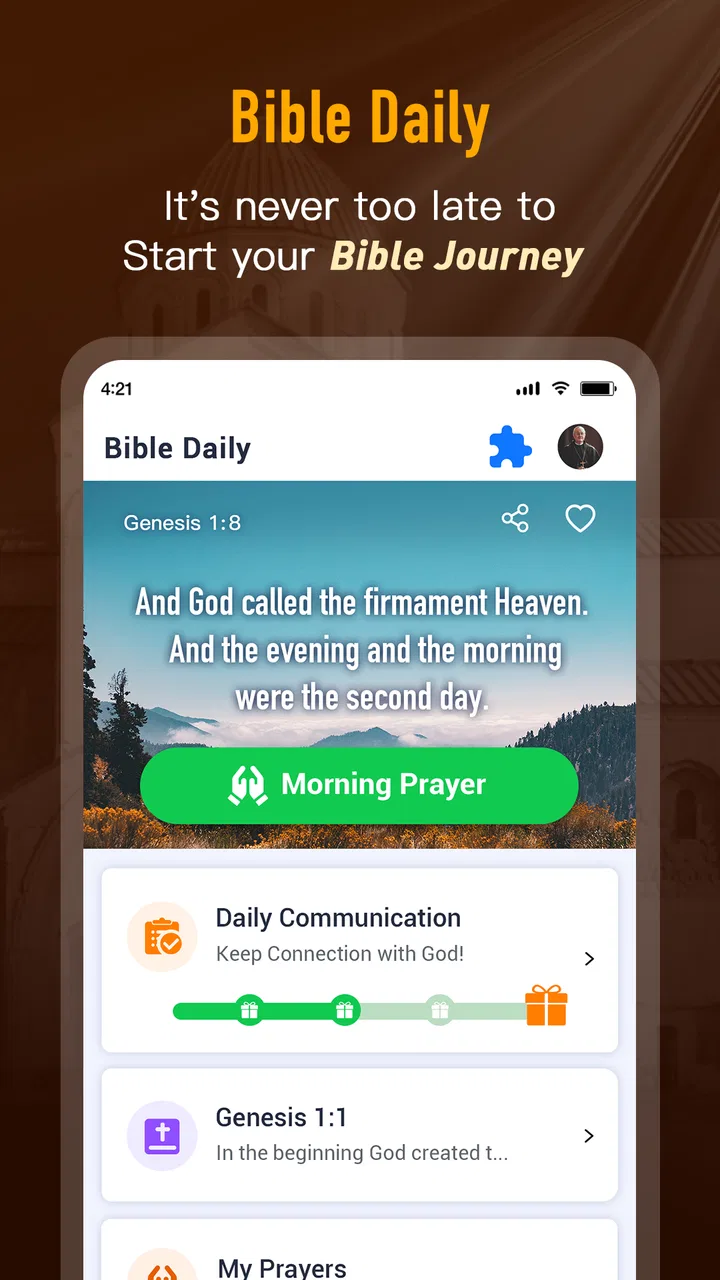
Bible Daily, KJV Bible + Audio
- 4.6
- Rating
- 5.00M
- Installs
- Free
- Price

 Analysis by App-foxy
I approached Bible Daily, KJV Bible + Audio as a practical reading companion rather than simply another digital Bible. It is a free Books & Reference app from WOOMBIT, built around the King James Bible, offline reading, audio, prayers, plans, Bible trivia, and an AI Priest feature. After spending time with it, I found its strongest quality is convenience: it brings several devotional habits into one place without requiring a separate reader, audio tool, quiz app, and prayer notebook.
That combination makes it easy to recommend to someone who wants a straightforward way to keep Scripture nearby throughout the day. It is especially useful for short reading sessions, listening while doing routine work, or following a more deliberate devotional rhythm. At the same time, it is not a perfect replacement for every Bible app. The King James wording will not suit everyone, and users who want deep academic study tools may eventually need a more specialized resource.
How Bible Daily fits into an everyday reading habit
The basic workflow is simple. I open the app, choose a passage, and read directly from the KJV text. When my attention is limited, I switch to audio instead of abandoning the session altogether. That small choice matters in real life: a morning reading can happen with the screen in hand, while an evening session can become a listening experience when reading feels tiring.
You May Also Like

 Blood Strike: 2.5 Anniversary
Blood Strike’s Loadouts Turn Every Drop Into a Tactical Gamble
A close look at Blood Strike’s custom loadouts: how fast access to signature weapons reshapes its battle royale rhythm, rewards preparation, and narrows the gap between fights.

 Pandora - Music & Podcasts
Pandora’s Music Is Easy to Start, but Harder to Recover
Pandora’s strength is its low-effort path from a seed to a station. Its weak spot is how much confidence it asks you to place in connection, setup, and quiet recovery.

 8 Ball Pool
 Is Built on Rivalries, Rematches, and Routine
A close look at the rivalries, rematches, shared routines, and unanswered safety questions that turn a quick pool match into a persistent mobile community.

 Samsung Music
’s Quiet Strength Is Playing What You Already Own
Its reach comes less from spectacle than from dependable access to a personal library. That simplicity is both the app’s strongest retention engine and its ceiling.

 AccuWeather: Weather Radar
AccuWeather Review: A Quick, Clear Forecast for Everyday Decisions
For everyday plans, the best forecast is the one you can understand quickly. AccuWeather makes rain timing, radar, and local conditions easy to act on, with a few trade-offs.

 Hill Climb Racing
Why Hill Climb Racing Still Turns Crashes Into One More Run
A tiny car, a bumpy hill and one more upgrade: Hill Climb Racing keeps resurfacing because its simple chaos makes every near-miss feel personal.
More From Our News Desk



The offline reading option is one of the most useful parts of the design. It means the app can remain relevant during travel, in places with unreliable service, or whenever I want to avoid depending on a connection. I would still prepare the passages I expect to use before leaving home, because offline access is most valuable when treated as part of a routine rather than tested at the last moment.
The KJV is a deliberate choice, not a neutral default. Its language has a formal, traditional character that many readers find meaningful, familiar, or beautiful. I enjoyed the sense of continuity it gives to a reading habit, but I would not suggest it automatically to someone who struggles with older English. If clarity and modern phrasing are the priority, a contemporary translation may be a better starting point, even if this app remains useful for its other features.
For a realistic daily scenario, I can imagine using it during a commute as a listening tool, then returning to the same passage later when I have time to read more carefully. At night, I might move from Scripture to a guided prayer or a plan instead of opening several unrelated apps. The value is not that each feature is revolutionary on its own; it is that the transitions between them are convenient enough to support consistency.
The app is also approachable for people who are new to structured Bible reading. Rather than asking a beginner to design a study system from scratch, it offers several directions: read, listen, pray, follow a plan, or test recall with trivia. That variety can help someone discover which habit feels sustainable. I would advise beginners to start with one path instead of trying everything at once, since too many options can turn a simple devotional moment into menu browsing.
Its reach is reflected in a 4.7 average from around 34 thousand ratings, with more than 5 million installs. Those figures suggest that the app has found a broad audience, but they do not remove the need to check whether its particular style fits you. Popularity is less important than the translation, reading tools, and level of study depth you personally need.
The first setup choices I would make
On a first visit, I would decide whether the app is mainly going to be a reading tool, an audio companion, or a complete devotional hub. That decision keeps the experience focused. If reading is the main goal, I would begin with a manageable passage and use the rest of the app as support. If listening is more realistic, I would test the audio early and make sure the presentation feels comfortable before building a routine around it.
I would also explore the prayer and plan areas before committing to a schedule. A plan can provide helpful structure, but a rigid routine is not automatically better than a flexible one. Someone with unpredictable days may get more value from choosing a passage whenever time appears, while another reader may appreciate having a defined sequence to follow.
The Bible trivia feature works best as a review tool rather than the center of the experience. I see it as a way to revisit what I have read and notice which details I remember poorly. Used after a passage, it can turn passive reading into a small act of recall. Used randomly, it may feel disconnected from a deeper study habit.
The AI Priest feature deserves a measured approach. I would treat it as a conversational aid for reflection, prompts, or questions that help me think about a passage. I would not treat an AI response as pastoral authority, theological scholarship, or a substitute for a trusted religious leader. That distinction is important: convenience can support reflection, but it should not decide sensitive spiritual matters for the user.
Settings and choices that deserve attention
Because the app combines text, audio, plans, prayer, trivia, and AI interaction, I recommend spending a few minutes checking how each area behaves before using it every day. The most useful setting is often not a dramatic feature but the choice that removes friction from the way you already live. If you usually read in short bursts, favor a layout and routine that let you return quickly. If you listen, make the audio path easy to reach.
Offline reading deserves particular attention. I would prepare the app while connected rather than assume every passage will be available exactly when needed. This is a practical habit for flights, rural travel, or a daily commute with inconsistent coverage. It also reduces the temptation to postpone reading because the app is waiting for content to load.
Audio should be tested in the environment where it will actually be used. A quiet room can make any narration seem comfortable, while traffic, household noise, or headphones may reveal whether listening is genuinely practical for you. I would try a short passage first, then decide whether audio belongs in a regular routine or is better reserved for occasional use.
In-app purchases range from $0.49 to $49.99 per item, so I would pay attention to any optional purchase screen and decide what I actually need before spending. The free entry point is a strong reason to try the app, but the presence of optional purchases means it is worth keeping the experience intentional. I prefer to use the core workflow for several days before deciding whether an extra item would meaningfully improve it.
The app is rated for Everyone, which makes it approachable for a wide audience. That does not mean every feature will be equally suitable for every age or level of maturity; parents and educators should still guide younger users when conversational or devotional features raise questions. For adults, the main consideration is not age access but whether the KJV style and the app’s blend of tools match their expectations.
Version 1.39 is the current version, and the minimum operating-system requirement is Android 5.0. That makes the app accessible on many older Android devices. I would still keep expectations realistic on aging hardware: a text reader may feel fine, while audio, transitions, or more interactive areas can feel less smooth than they do on a newer phone.
Faster patterns for people who want less tapping
Experienced use is mostly about repeatable habits. My preferred pattern would be to choose a daily reading route, keep the app available offline, and use audio when the normal reading window disappears. This avoids making a fresh decision every time. The less effort required to begin, the more likely the habit is to survive busy days.
A useful two-pass method is to listen first and read later. Listening gives me a broad sense of the passage when my hands are occupied, while reading afterward lets me slow down and notice wording that passed too quickly. The reverse also works: read a short section carefully, then listen to reinforce its rhythm. The best order depends on whether comprehension or continuity is the immediate goal.
I would use plans as a map, not a command. If a plan is helping me return consistently, I would keep it. If it starts making the app feel like another obligation, I would reduce the session rather than quit completely. A short, repeatable reading habit is more useful than an ambitious schedule that collapses after a few days.
Trivia can fit neatly into this pattern. After finishing a passage, I can use a quiz as a memory check, then return to the text when an answer exposes a gap. That creates a simple loop: read, recall, revisit. It is more productive than treating trivia as a standalone game, especially for readers who want to remember themes and details rather than merely finish pages.
Prayer tools can also be used at transition points. Instead of opening the app only for a long devotional session, I can read a short passage, pause for a guided prayer, and close it without feeling that the session was incomplete. This makes the app suitable for lunch breaks, a quiet moment before bed, or a brief reset between tasks.
One trade-off is that an all-in-one app can encourage switching between features. I recommend choosing the next action before opening a session: read, listen, pray, follow the plan, or review with trivia. That small rule keeps the convenience from becoming distraction. The app is at its best when its features support one another, not when they compete for attention.
Where the app reaches its limits
The biggest limitation is the translation itself. The KJV offers a distinctive literary and religious voice, but its vocabulary and sentence structure can slow down readers who are unfamiliar with older English. If you are studying a difficult passage and need modern wording, multiple translations, or extensive comparison tools, a dedicated Bible study app is likely the better choice.
I also would not choose this as my only resource for serious theological research. The app’s strength is bringing reading, listening, prayer, plans, trivia, and AI-assisted reflection together. That is different from providing a full scholarly workspace with extensive cross-references, original-language tools, commentary libraries, or detailed note systems. Readers who need those capabilities should use Bible Daily alongside a more specialized reference rather than expecting it to cover everything.
The AI Priest feature has a similar boundary. It may help generate a question, suggest a reflective angle, or make a passage feel more approachable, but users should verify important interpretations through Scripture, trusted teachers, or established resources. I would be particularly cautious about using automated guidance for personal crises, doctrinal disputes, or decisions with serious consequences.
There is also a concentration issue. The app offers enough variety that a user could spend more time changing modes than reading. This is not a flaw unique to the app, but it is noticeable here because the reading experience sits beside several additional activities. A simple personal rule—one primary feature per session—solves much of the problem.
Compared with a printed KJV Bible, the app is more portable and adds audio, plans, trivia, prayer support, and AI interaction. The book still wins for users who want a quiet, distraction-free physical experience and do not need those extras. Compared with a general Bible reader, this app is more focused on devotional convenience than on building a broad study library. Compared with separate audio, prayer, and quiz apps, it is less fragmented, though a specialist app may offer greater depth in one area.
Privacy-minded users should approach the interactive features thoughtfully and review the app’s behavior and permissions on their own device before using them extensively. I would keep sensitive personal details out of any AI conversation regardless of the app, and I would use it for general reflection rather than recording private pastoral matters.
Who will get the most from it
I think Bible Daily is a strong fit for someone who wants the KJV close at hand and values a mixture of reading and devotional support. It suits commuters, travelers, beginners building a habit, and readers who appreciate being able to move from a passage to audio or prayer without changing apps. It is also a sensible option for people who often have short, irregular windows rather than one long study period.
It is less suitable for a reader who dislikes traditional English, wants a purely academic study environment, or prefers a distraction-free paper Bible. It may also frustrate someone who wants every feature to be deeply customizable or who expects an AI tool to provide authoritative spiritual answers. In those cases, a modern-translation reader, a scholarly Bible platform, or a conventional book may be a better primary choice.
The free price makes experimentation easy, while the optional purchases mean I would still make deliberate choices inside the app. Its Everyone rating and support for Android 5.0 broaden its accessibility, but the real deciding factor remains the user’s preferred translation and workflow. I would not install it simply because it has many tools; I would install it because those tools address a specific need in my routine.
My verdict after building a repeatable routine
Bible Daily, KJV Bible + Audio succeeds because it turns several small devotional actions into one approachable routine. I found the offline reading, audio option, plans, prayer guidance, trivia, and AI feature most valuable when used with clear boundaries. The app does not need to replace every other Bible resource to be worthwhile; it only needs to make regular engagement easier.
My recommendation is strongest for KJV readers who want flexibility. Start with the text, prepare offline access, test audio in your normal environment, and add plans or trivia only when they support the habit. Use the AI Priest as a prompt for reflection rather than a final authority. That approach keeps the app useful without asking it to do more than it can reasonably do.
WOOMBIT has created a practical free entry point for Bible reading on Android, and the broad response—around 1.8 thousand written reviews alongside its larger rating base—shows that many users find the format worthwhile. I would choose it for convenience, continuity, and devotional variety, while keeping a separate trusted resource nearby for deeper study. If that balance matches what you want, this is an app I would comfortably recommend to a friend.
FAQs for Bible Daily, KJV Bible + Audio
01What features does the Bible Daily, KJV Bible + Audio app offer?
The app provides a comprehensive King James Version (KJV) Bible experience with features such as daily verse notifications, an audio Bible for listening on the go, and a bookmarking system for favorite passages. It also includes a search function for easy navigation and a daily devotional to enhance your spiritual journey.
02Is an internet connection required to use the Bible Daily, KJV Bible + Audio app?
While the app offers offline access to the text of the KJV Bible, certain features like audio playback and daily devotional updates may require an internet connection. Make sure to download any necessary content in advance if you plan to use the app without internet access.
03Are there any in-app purchases or advertisements in the Bible Daily, KJV Bible + Audio app?
The app is free to download, but it may include advertisements. There are often in-app purchase options available to remove ads and unlock additional features. Always check the app’s details on the download page to understand any costs associated with premium features.
04How user-friendly is the Bible Daily, KJV Bible + Audio app for beginners?
The app is designed with a user-friendly interface, making it accessible for both beginners and seasoned Bible readers. It provides easy navigation, a clean layout, and intuitive controls for audio playback. New users will find the tutorial and help sections useful for getting started.
05How does the audio feature work in the Bible Daily, KJV Bible + Audio app?
The audio feature allows users to listen to the Bible, making it convenient for those who prefer auditory learning or have visual impairments. Simply select the chapter and press play. The audio quality is clear, and you can control playback speed and chapter selection easily within the app.
Pros
- Easy-to-navigate interface for all users.
- Offline access to scriptures is available.
- Audio playback for hands-free listening.
- Customizable reading plans and reminders.
- Comprehensive search function for quick access.
Cons
- Contains occasional ads that may distract.
- Limited translations besides KJV.
- Requires internet for some features.
- Audio quality can be inconsistent.
- Color themes are not highly customizable.

Bible Daily, KJV Bible + Audio
Gallery